
How the combination of rubber and high-chromium cast iron can enhance high-stress abrasion resistance under high-energy impact conditions.
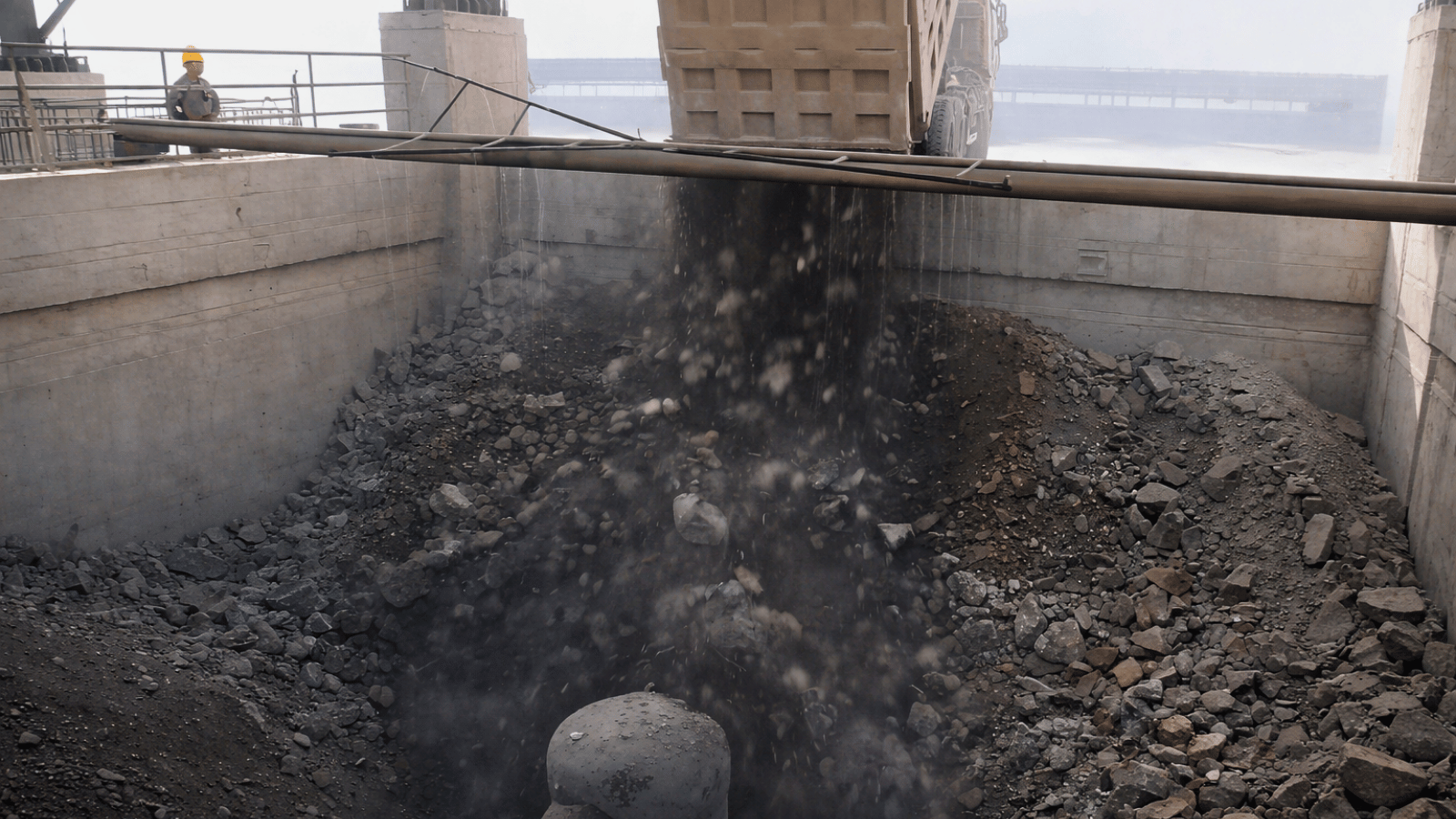
Primary discharge conveyor deflector liners are subjected to two simultaneous load: high-energy impact during initial contact and intense abrasive sliding (gouging abrasion) immediately afterward. Traditional liner systems are usually designed to reduce a single abrasion mechanism. When exposed to both forces simultaneously, they tend to wear unevenly, leading to localized failure.
Conventional impact mitigation systems such as suspended chains, semi-rigid curtains, and rubber curtain provide limited control over particle trajectory and energy dissipation within the deflector chamber. While partially reducing bulk impact energy, these systems do not effectively restrict the through-pass of fine particles, nor do they provide directional control of material flow across crusher subsections.
Uncontrolled material distribution makes non-uniform loading and localized impact concentration within the liner strike zone. This generates differential wear kinetics, accelerates material loss, and promotes premature failure in regions subjected to elevated contact stresses. Furthermore, uncontrolled gangue trajectory along the primary impact vector amplifies combined impact–abrasion mechanisms, intensifying surface fatigue, micro-fracture initiation, and progressive liner degradation.
The cumulative effect is reduced liner service life, compromised wear predictability, and increased frequency of unplanned maintenance shutdowns due to uneven wear progression and sudden liner failure.
The Soluroc Hybrid impact liner is an engineered composite wear system integrating Flexarmor® elastomeric energy-absorbing media with Abreco high-chromium laminated wear plate to optimize impact reduction and tribological performances.
The elastomeric phase functions as a viscoelastic damping layer, dissipating impact energy through elastic deformation and reducing peak contact stresses transmitted to the substrate. Simultaneously, the embedded high-chromium laminate provides high hardness, delivering enhanced resistance to gouging abrasion, high-stress scratching, and erosive wear.
This multi-phase configuration mitigates stress concentration, improves load distribution, stabilizes wear mechanisms, and significantly extends liner service life under severe impact-abrasion operating conditions.
High Impact Zones in Modern Mining Operations
In modern mining operations, high-energy impact zones are unavoidable due to increased throughput, larger feed sizes, and elevated drop heights, which collectively amplify the kinetic energy transferred to process equipment. The resulting high contact stresses promote severe high-stress abrasion and accelerate wear under dynamic loading conditions.
Discharge deflector is a typical example of such a high impact condition, where high-frequency impact is combined with severe abrasive loading. The elevated drop height and mass flow rate result in substantial energy transfer to liners and structural components, accelerating impact fatigue and abrasive wear under continuous operating conditions.
The Wear Mechanism under the Impact and Abrasion
The wear mechanism under combined impact and abrasion is governed by the co-operative interaction between dynamic loading and abrasive material removal. High-energy impacts generate localized plastic deformation, subsurface shear stresses, and micro-crack initiation due to repeated stress-wave propagation. These impact-induced defects reduce the structural integrity of the surface layer, making it more susceptible to abrasive penetration. Simultaneously, hard particles sliding or gouging across the surface cause micro-cutting, plowing, and micro-fracture, progressively removing material. The abrasive action exposes fresh surfaces and intensifies stress concentration at existing flaws, accelerating crack propagation and material loss. This coupled tribo-mechanical process results in non-uniform wear, localized high-stress zones, and significantly elevated degradation rates compared to impact or abrasion acting independently.
Table 1 – shows the available material solutions with their strengths and limitations under high Impact–wear conditions
| Material System | Abrasion Resistance | Impact Tolerance | Fracture Risk | Best Use Case |
| Steel | Moderate | High | Low | Structural Liners |
| Rubber | Low-Moderate | Very High | Very Low | High impact, low abrasion |
| Ceramic | Very High | Low | High | Sliding abrasion |
| Hybrid (Abreco® + Flexarmor®) | Very High | High | Low | Combined impact + abrasion |
Under severe service conditions characterized by high contact stresses and aggressive, hard feed materials, an effective mitigation strategy is to reduce peak impact stresses while integrating high-hardness, abrasion-resistant surfaces through a hybrid liner configuration.
By incorporating an elastomeric rubber matrix for impact energy absorption together with Abreco high-hardness wear plate as reinforce, the system dissipates dynamic loads while maintaining superior resistance to gouging and high-stress abrasion. This hybrid architecture addresses both impact fatigue and abrasive wear mechanisms, resulting in improved structural stability, reduced stress concentration, and extended service life in impact–abrasion environments.
Flexarmor® Energy Management in the Abrasion mechanism
Flexarmor® is an engineered elastomeric compound developed for controlled kinetic energy reduction in high-impact environments. The formulation is optimized to dissipate dynamic impact energy, prevent tear initiation and propagation, maintain elastic recovery under cyclic loading, and preserve mechanical integrity under severe operating conditions. Additionally, the compound sustains high abrasion resistance under combined impact–abrasion loading.
Each mechanical property is engineered to support a specific functional response to impact loading, as summarized in Table 2.
Table-2 Main Flexarmor® specification and their key performance
| Property | Value | Performance |
| Hardness | 70 Shore A | Balanced compliance for impact energy absorption with structural stability |
| Tensile Strength | 2,900 psi | Resists rupture under cyclic impact loading |
| Elongation at Break | 470% | Accommodates high elastic deformation without permanent damage |
| Tear Strength | 450 lbf/in | Limits rip initiation and propagation |
| DIN Abrasion Loss | 60–80 mm³ | Provides resistance to sliding abrasion |
| Low-Temperature Brittleness | PASS at –70°C | Maintains toughness in cold environments |
Abreco® chromium white iron Reinforcement
Abrasion resistance in high-impact zones is controlled not only by surface hardness, but by the microstructural stability of the material under repetitive compressive shock and dynamic loading. Abreco® inserts consist of laminated high-chromium white cast iron manufactured in accordance with ASTM A532, with tightly controlled alloy chemistry and heat treatment to optimize the balance between hardness, impact toughness, and fracture resistance.
Through the laminated composite configuration, the inherent brittleness of monolithic high-chromium cast iron is mitigated, enhancing fracture toughness and crack-arrest capability while preserving a high-hardness martensitic–carbide microstructure. This engineered structure enables performance approaching that of alloy steels in toughness while maintaining superior resistance to high-stress abrasion, as summarized in Table 3.
Table-3 Key properties of the Abreco laminated plate
| Property | Performance Range | Performance |
| Hardness | Up to 800 HB | Resists to abrasive wear |
| Compressive Yield Strength | Up to 2700 MPa | Withstands high localized impact loads |
| Impact Energy | Up to 210 J | Improves resistance to brittle fracture |
| ASTM G65 Abrasion Resistance | <0.12 gr | Extends service life in abrasive environments |
Conventional high-chromium white irons typically contain sharp, angular, and partially interconnected M₇C₃ carbides that function as inherent stress concentrators. Under repetitive impact and compressive shock loading, these morphologies promote localized stress intensification, facilitating crack initiation and rapid propagation through the brittle eutectic carbide network.
In contrast, Abreco® components are engineered with a refined microstructure featuring round ended, discrete, and densely distributed chromium carbides within a martensitic matrix. The modified carbide morphology reduces stress concentration, improves crack deflection and arrest behavior, and enhances fracture tolerance while maintaining high hardness. This optimized carbide distribution increases both impact toughness and resistance to high-stress abrasion, as illustrated in Figure 1.
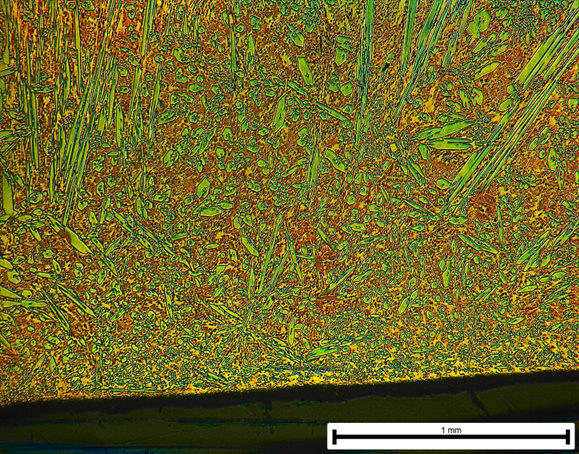
Figure 1 – Discrete chromium white iron morphology in Abreco® laminated plates showing round ended and uniformly distributed M₇C₃ carbides within a martensitic matrix.
Conclusion:
The hybrid composite configuration includes the Flexarmor, which is uniquely designed for high bounce and impact resistance. Combined with high-toughness, high-chromium laminated Abreco® plates, it offers superior abrasion resistance under conditions of frequent heavy impacts. This ensures stability and extends the service life, facilitating uniform material flow across a wide range of trajectories where stability and durability are essential.