
In industrial environments, the accuracy of field measurements directly impacts fabrication quality, installation efficiency, and overall project predictability.
Traditionally, piping systems have been measured manually - often in challenging conditions involving elevation, restricted access, or active operations. While experienced teams can achieve reliable results, manual methods introduce variability, require multiple site visits, and may increase the likelihood of rework when dimensional assumptions differ from field reality.
To strengthen measurement precision and reduce uncertainty, Soluroc Sudbury has integrated advanced 3D laser scanning technology into its workflow.
Moving from Manual Estimation to Digital Field Capture
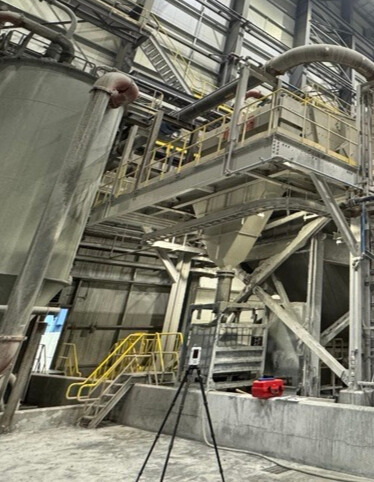
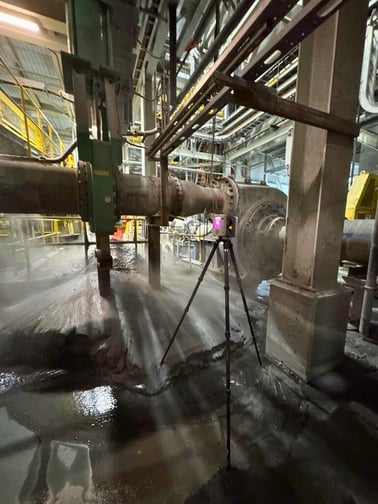
Using high-resolution terrestrial laser scanning equipment, field environments can now be digitally captured in the form of detailed point cloud data. This technology records millions of spatial data points, creating an accurate three-dimensional representation of piping systems, structural supports, and surrounding infrastructure.
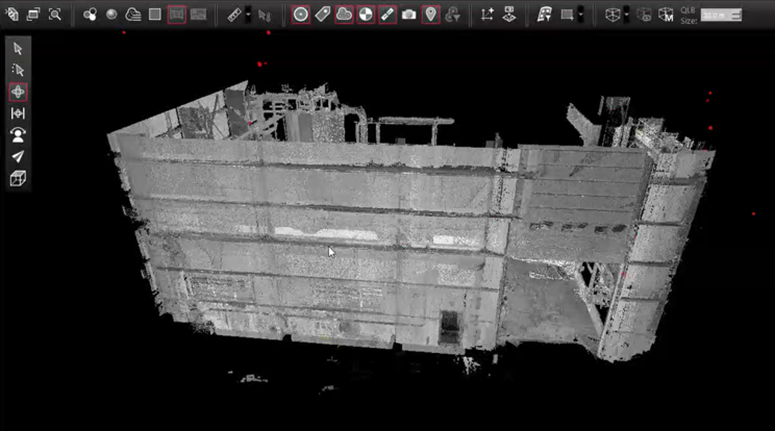
Rather than relying solely on tape measurements or manual sketches, engineers can reference a complete digital model of the installation. This allows for:
- More precise dimensional validation
- Improved visibility of tie-in locations
- Reduced reliance on assumptions during quoting
- Enhanced coordination between field and fabrication teams
The result is a more structured transition from site conditions to fabrication-ready documentation.
From Point Cloud to Fabrication-Ready Outputs
Digital capture is only valuable when it integrates seamlessly into fabrication processes.
Scan data is registered and processed using industry-standard point cloud software, then translated into CAD-based pipe models and fabrication-ready spool drawings.
Point cloud data can be translated into CAD-based pipe models and spool drawings, including component identification such as valves, flanges, reducers, elbows, and pipe segments. This structured approach supports:
- Clear part identification
- Organized spool documentation
- Improved traceability within internal systems
- Alignment between field conditions and shop production
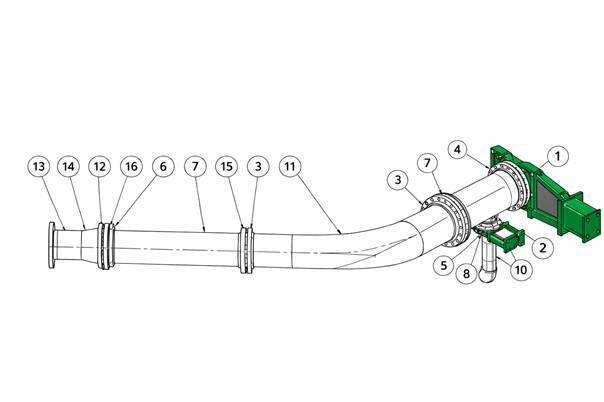
By reducing ambiguity early in the process, fabrication teams gain greater confidence that components will align as intended during installation.
Supporting Operational Predictability
While 3D scanning is widely used across engineering and construction industries, its integration into Soluroc Sudbury workflows reflects a broader commitment to operational modernization.
The objective is not to replace expertise, but to complement it.
Digital field capture provides an additional layer of validation that can:
- Reduce the risk of unexpected dimensional discrepancies
- Minimize potential field modifications
- Improve planning for shutdown or replacement activities
- Strengthen coordination between engineering, fabrication, and installation
Over time, structured digital documentation may also support improved asset recordkeeping and system traceability.
A Measured Step Toward Digital Integration
The adoption of 3D scanning technology represents a deliberate investment in precision and process improvement. By combining advanced measurement tools with fabrication expertise, Soluroc Sudbury continues to refine how piping systems are evaluated, modeled, and prepared for replacement or modification.
This initiative reflects Soluroc’s broader commitment to investing in technologies that enhance safety, accuracy, and long-term operational reliability.
As industrial facilities face aging infrastructure and increasing performance expectations, integrating digital tools into established engineering practices helps reduce uncertainty and support more predictable outcomes.
About Soluroc Sudbury
Soluroc Sudbury (formerly Fuller Industrial) specializes in carbon steel and rubber-lined piping systems for mining and heavy industrial applications. With extensive experience in concentrator, thickener/clarifier, and hydrometallurgical projects, the operation delivers fully integrated solutions—from detailed engineering and spool modeling through fabrication, lining, coating, and global logistics.
Operating from a single integrated facility in Ontario, Soluroc Sudbury combines advanced CNC pipe profiling, robotic welding, large-scale rubber lining capacity, and in-house testing to ensure precision and consistency across complex projects.
Supported by certified quality systems including ISO 9001 2015, ASME, TSSA, NACE, CWB etc standards, and reinforced by full traceability through serialized production tracking, Soluroc Sudbury’s mandate remains clear: deliver engineered piping systems on spec and on time.